Tripoli HPR Senior Mentor and Flyer of Record Program

The Tripoli HPR Senior Mentor and Flyer of Record (FoR) Program is primarily in support of student HPR rocket competitions where the students are still learning HPR and may not have the certification for the motors used in the competition. The Mentor/FoR program can also be applied to non-competitive launches.
Student teams may need assistance and expertise in a variety of areas. These areas include the rocket itself, but also other areas that may be critical to the success of the team. One role of a Mentor is to engage with the team in the design and building of their rocket to ensure it will safely withstand the stress of flight and recovery. Mentors assisting a team in this manner should have personal experience with the design, build, and flight aerodynamics of the type of rocket and motor to be used by the team they are mentoring. Another role of a mentor is to assist the team in areas not directly related to the construction of the rocket. Examples might include fundraising, obtaining visas, or project managing & scheduling.
Mentors do not need to be physically located with the team and can perform their duties using various means of communication including video calls. Mentors do not necessarily need to be Tripoli members, or be high-power certified, or commit to attend the on-site competition.
The roles of Mentor and FoR are different. The FoR will be signing the flight card at the test flights and competitions, and must therefore be present at these launches. A FoR must be a senior member of Tripoli in good standing with good understanding of the
Tripoli Unified Safety Code. Likewise, the FoR should have personal experience with flight safety, RSO checks, pad operations, and LCO and recovery operations for the rocket used by the team. It is the responsibility of the FoR to verify in person at the launch that the rocket is safe to launch and recover. A single person may fulfill both the Mentor and FoR roles, but it can also be split between multiple people.
Competition Requirements
The specifics of the requirements for a student competition are dependent on the particular competition of interest. Eligibility requirements also vary between different competitions. Therefore, one needs to obtain this information from the organization running the competition of interest.
Mentors
It is recommended that a Mentor be certified by the Tripoli Rocketry Association (TRA) at the appropriate level for the class of motor being used. However, certification is not a requirement, and Mentors assisting in areas outside of the rocket design itself do not need to be Tripoli members and to not need to be certified.
Mentors must have sufficient experience with building, flying, and recovering rockets of the level their team is using so that they can recognize design flaws and make the necessary recommendations to correct those flaws. It is recommended that Mentors have built and flown at least 5 rockets of the appropriate level, with at least one of those built from scratch, not from a kit. Mentors must be familiar with the design and flight rules for the competition. Mentors must also be familiar with the Tripoli Unified Safety Code and state and local laws and regulations pertaining to rocketry.
It is not required for the Mentor to attend the competition launch; however the Mentor should attend design reviews held online. The Mentor is responsible for providing design and building guidance to the team to produce a rocket that will be safe to fly and recover. It is not the role of the Mentor to perform design calculations or simulations, or to perform any of the work in actually building the rocket.
Examples where Mentor experience and expertise would be helpful are listed below.
SRAD Solid Motor Categories
Some competitions may include a Student Researched And Designed (SRAD) solid motor category. This is where the team designs and builds their own motor. Mentors for teams in the SRAD solid motor categories must have experience building High Power Rocketry (HPR) solid fuel motors. It is acceptable to have a Mentor for the rocket and a separate Mentor for the SRAD motor. Mentors for SRAD solid motors should be familiar with grain geometry (grain diameter, core diameter, web thickness and grain length, number of grains); nozzle characteristics (throat diameter and erosiveness) as it pertains to Kn, pressure, burn time, initial impulse, and total impulse; and burn characteristics. SRAD solid motor Mentors should have experience in designing and building the type of motor being built by the team (e.g. APCP packable propellant, APCP pourable propellant, sugar, etc.), including handling of fuel and oxidizer components, curatives, etc. The TRA Unified Safety Code requires potassium nitrate as the oxidizer and Dextrose, Erythritol, and/or Sorbitol as the primary fuel in sugar motors.
SRAD Hybrid Categories
Some competitions may include a SRAD Hybrid motor category. Mentors for teams in the SRAD hybrid motor category must have experience building HPR hybrid motors. Note that the Tripoli Unified Safety Code allows only Nitrous Oxide as an oxidizer. The Mentor must be experienced in safely handling liquefied nitrous oxide. This includes handling at elevated ambient temperatures as experienced in the summer.
Motor Hardware
SRAD motor Mentors must have experience and knowledge regarding motor hardware, including motor cases, closures, nozzles, injector bells and plates, and injectors. All SRAD bipropellant liquid fuel motor hardware must be in compliance with the Section 10-10 Case Components described in Research Motors section of the TRA Unified Safety Code.
Two-Stage Rocket Experience
A competition may include a 2-stage rocket category or allow 2-stage rockets. The 2-stage rocket Mentor should have design and flight experience with multiple 2-stage high power rockets. This experience should include determining stability (Cp and Cg) for both the launch configuration (booster plus sustainer) and the sustainer alone.
Launch pad safety is more involved with 2-stage rockets. The 2-stage Mentor must be familiar with how to design for safe loading, arming, and installation of igniters for both stages at the pad. The Tripoli Unified Safety Code requires “Staging devices, if any, shall be armed after recovery devices but before the launch igniter is connected to the launch system.” The 2-stage Mentor must also be familiar with how to safe and disarm staging and ejection events.
Critical to safe 2-stage flight operation are the events of stage separation, sustainer coast time, sustainer ignition, and the orientation of the sustainer when ignited. A tilt function in the sustainer flight electronics is strongly recommended to prevent unsafe downward trajectories or long-distance recoveries. The 2-stage Mentor should be familiar with methods to control stage separation, determining sustainer coast time and sustainer tilt, and sustainer ignition methods and time for sustainer motor to pressurize.
Recovery of 2-stage rockets by nature involves more parts to track and find. Additionally, the sustainer will be much heavier if the sustainer motor does not ignite. Sustainer main parachute sizing must take this into account.
Other Mentor Assistance
An important goal of a mentor should be to get the team “to the competition”. There are many examples of teams that had a safe rocket built and ready to fly but were unable to attend a competition because of other issues. Examples of the issues they encountered included insufficient funding for travel, an inability to procure Visa’s for international travel, difficulties with their university procurement functions, poor project & schedule management, etc. Mentor assistance in these areas can be critical, particularly for inexperienced teams.
Flyer of Record (FoR)
 Certification Level and Experience
The roles of Mentor and FoR are different. In contrast to the Mentor, the FoR must be a Tripoli member and must be certified by TRA to the level of the motors used in the rocket. FoRs must have sufficient experience with building, flying, and recovering rockets at the level used by the competition team so that they can perform a detailed Flight Safety Review (FSR) on all aspects of the rocket they are sponsoring.
FoRs must be familiar with both the competition rules and the Tripoli Unified Safety Code, and be ready and willing to intervene to prevent their sponsored rocket from launching if the launch site and conditions are not in compliance with the Code. FoRs must also be familiar with state and local laws and regulations pertaining to rocketry and rocket launches.
FoR Roles and Responsibilities
The FoR is responsible for providing safety review guidance to the team to ensure the rocket assembly and planned flight are safe. The FoR has the authority to suspend or deny the rocket flight by withdrawing their FoR approval. It is not the responsibility of the FoR to fix launch site conditions or rocket defects to meet the Tripoli Unified Safety Code, only to ensure the site conditions and rocket are safe and in compliance with the Tripoli Unified Safety Code.
Flight Readiness Review
It is strongly recommended that design reviews and a Flight Readiness Review (FRR) be performed by the FoR well in advance – perhaps by months – of the competition launch. These reviews are intended to provide a “new eyes” review of the entire design as well as the team’s checklists and flight procedures. During this review, the FoR will identify concerns and deficiencies which must be addressed by the team, and verified by the FoR. It is best for the FRR to be performed far enough ahead of the competition to allow the team time to make any fixes.
Presence
The FoR must be present with the team for each stage of the process at the launch event. Specifically, they must be present for:
- Flight safety check,
- Completion of the flight card,
- RSO check,
- Supervision of loading the vehicle on the pad,
- Arming of electronics,
- Insertion of the igniter, and
- Removal of the igniter and disarming of the electronics in the event of a launch pad abort.
Checklists
The FoR should provide guidance to the team in developing their checklists. At a minimum there should be a pre-flight checklist and an abort checklist. It is recommended that a recovery checklist also be prepared. A hard copy of the pre-flight checklist must be presented at the FSR and/or to the RSO.
Flight Card
Most competitions use a Flight Card. The Flight Card may be required to be presented during the FSR, at the launch site for the Range Safety Officer (RSO) check, and at the pad to the Pad Manager. The FoR must sign the Flight Card for the rocket to be reviewed and approved to fly. It is the team’s responsibility to have the Flight Card in hand for the FSR, RSO check, and at the pad.
Flight Safety Check
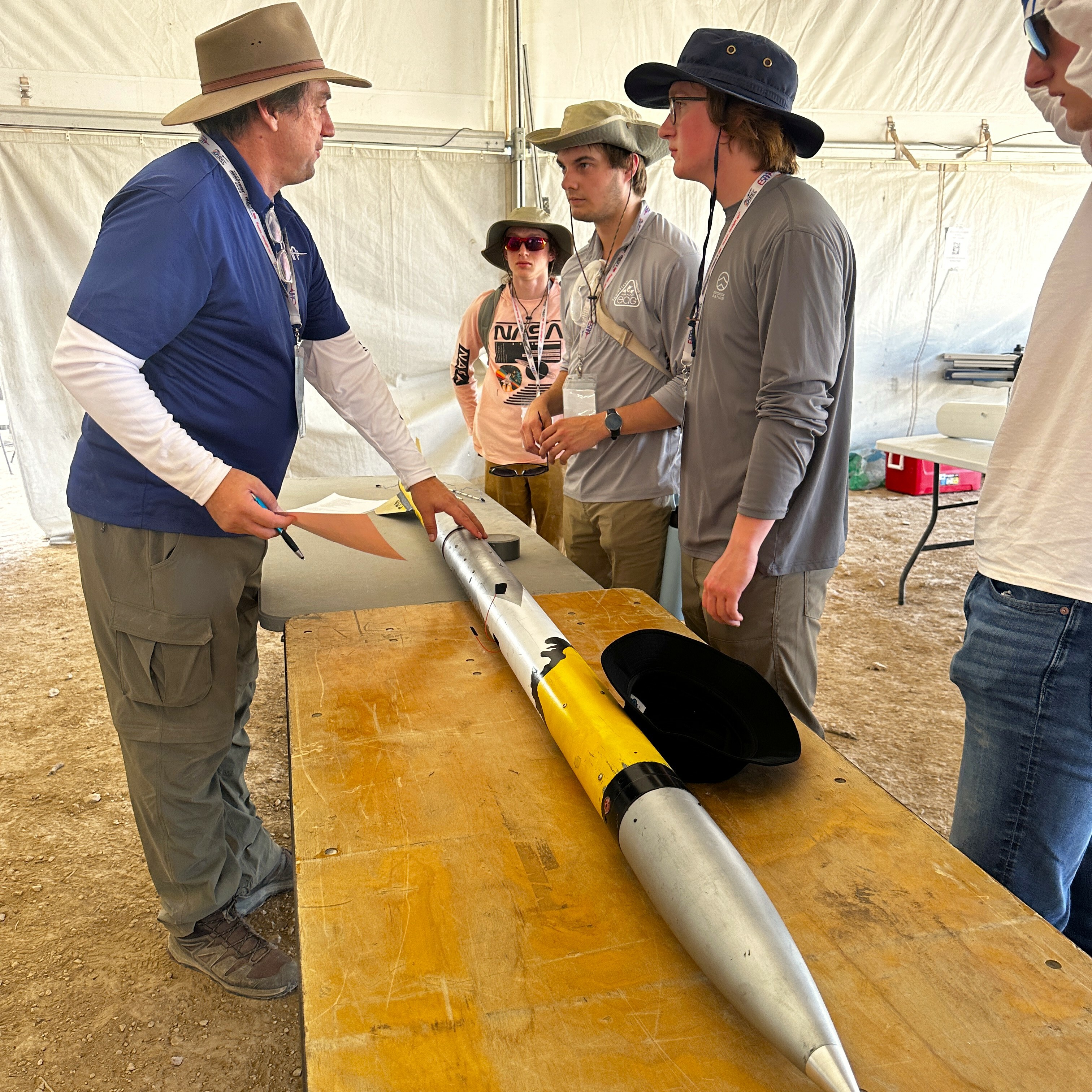
Some competitions may have a Flight Safety Check in addition to an RSO check. The FoR must attend the Flight Safety Check with the team and the team’s rocket. Flight Safety Reviewers will ask many questions about the rocket design, construction, and operation. Generally, these questions are directed to the student team and should be answered by the students. However, there may be specific questions during the FSR that are asked of the FoR that the FoR must answer.
 RSO Check
Competitions require an RSO check of the rocket when it is fully prepped for flight. The team lead will present the rocket and flight card to the launch site RSO for the check. The FoR is required to be present for the RSO check.
Launch Pad Duties
All launch pad activities must be performed according to the Tripoli Unified Safety Code.
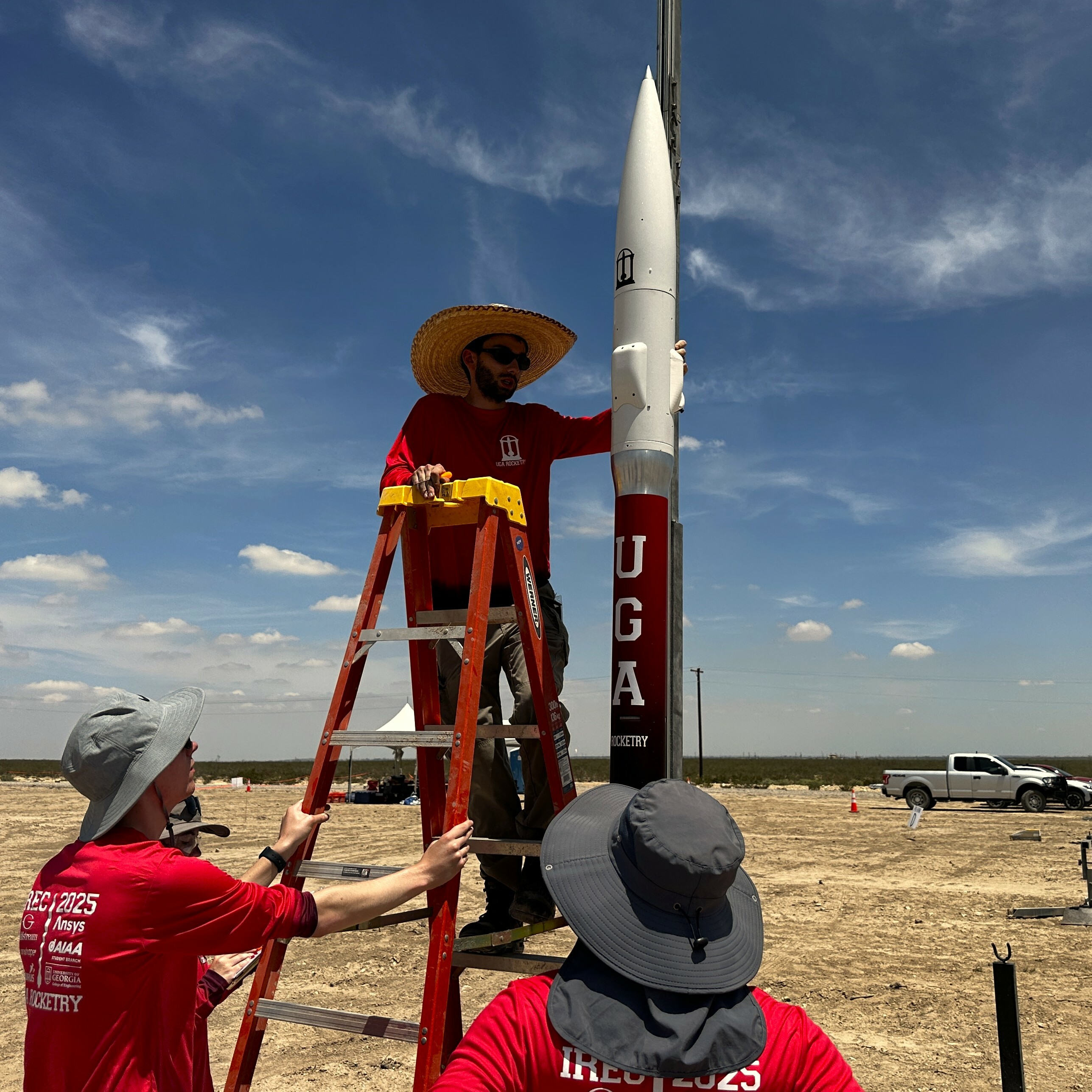
The FoR must be present at the pad with the team when the rocket is mounted on the launcher, erected vertical, electronics are armed, and the igniter installed. All pad activities are subject to the direction of the Pad Manager, RSO, or LCO. Failure to follow the direction of the Pad Manager, RSO, or LCO may result in flight cancellation and team disqualification.
It is the responsibility of the team lead to have the pre-flight checklist readily available and to ensure the team is following the checklist. It is also the responsibility of the team lead to ensure all team members are using the necessary Personal Protection Equipment (PPE). The FoR should be monitoring the team activity in using the pre-flight checklist, using PPE, and following the Pad Manager/RSO/LCO instructions to ensure safety.
When the rocket is mounted vertical on the launcher, electronics are armed, and the Pad Manager/RSO/LCO gives approval, the FoR may be responsible for the installation the igniter in the rocket and connecting it to the launch controller. Together, the Team Lead and the FoR will observe or perform a continuity check.
In the case of a hybrid or bi-propellant liquid fuel motor, the FoR should ensure that flight tanks are filled using a remote fill and dump system.
Launch Abort
In the event of a launch abort, the FoR is responsible for disconnecting the igniter and removing the igniter from the rocket, if the Pad Manager/RSO/LCO has not already done so. For hybrid and bi-propellant liquid fuel motors, the flight tanks must be emptied using a remote dump system. It is the responsibility of the team lead to have the abort check list readily available and to ensure the team is following the checklist. The FoR should be monitoring the team activity in using the abort checklist, using PPE, and following the Pad Manager/RSO/LCO instructions to ensure safety.
Recovery
The designated recovery personnel of the team are responsible for following the recovery procedures in the competition operating procedures and recovering the rocket. Unless the FoR is designated part of the recovery team, the FoR is not responsible for rocket recovery.
Tripoli Unified Safety Code